
Why Your Website PageSpeed Score Matters for Malaysian Businesses
A slow website loses customers. Learn how PageSpeed impacts your Google rankings, conversion rates, and customer trust in Malaysia.
Adam Yong
RM1 Website

Your Website Speed Is Costing You Customers Right Now
Here is a stat that should alarm every Malaysian business owner: Google’s research shows that 53% of mobile users abandon a website that takes more than three seconds to load. In Malaysia, where over 70% of internet traffic comes from mobile devices, this means a slow website is actively driving away more than half your potential customers before they even see what you offer.
I have been in the web and SEO industry for over 20 years, and website speed has gone from a nice-to-have to an absolutely critical business factor. Google now uses page speed as a direct ranking signal, which means a slow website hurts you twice, once by driving visitors away, and again by pushing you down in search results so fewer people find you in the first place.
Let me explain exactly how PageSpeed works, why it matters so much for Malaysian businesses specifically, and what you can do about it.
What Is Google PageSpeed and How Is It Measured?
Google PageSpeed Insights is a free tool that analyses your website’s loading performance and assigns a score from 0 to 100. You can test any website by going to pagespeed.web.dev and entering the URL.
The scores are categorised as:
- 90 to 100 (Green): Fast - excellent performance
- 50 to 89 (Orange): Moderate - needs improvement
- 0 to 49 (Red): Slow - significant performance issues
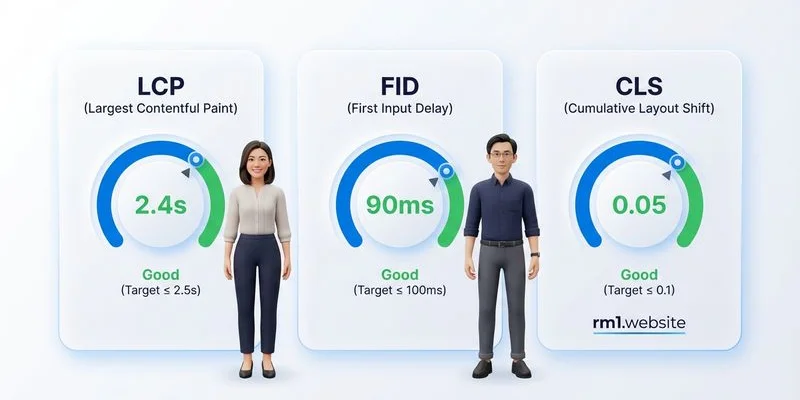
Google measures several specific metrics called Core Web Vitals:
Largest Contentful Paint (LCP): How long it takes for the largest content element (usually an image or heading) to load. Target: under 2.5 seconds.
First Input Delay (FID) / Interaction to Next Paint (INP): How long it takes for your page to respond when a user interacts with it (clicking a button, tapping a link). Target: under 200 milliseconds.
Cumulative Layout Shift (CLS): How much the page content shifts around while loading. Ever tried to tap a button on a mobile site and the page jumped, making you tap something else? That is layout shift. Target: under 0.1.
These metrics are not just academic measurements. Google uses them directly in its ranking algorithm, and they have real, measurable impact on whether visitors stay on your site or bounce.
The State of Website Speed in Malaysia
Let me share some numbers that paint a concerning picture for Malaysian businesses. Based on data from the Chrome User Experience Report and my own audits of Malaysian business websites:
- The average Malaysian business website scores 35 to 55 on mobile PageSpeed
- The average page load time for Malaysian business websites is 4.5 to 7 seconds on mobile
- Over 60% of Malaysian SME websites fail Core Web Vitals assessment
- WordPress sites with typical plugin configurations average 25 to 45 on mobile
- Free website builder sites (Wix, Squarespace) average 30 to 50 on mobile
Meanwhile, the websites sitting at the top of Google search results for competitive Malaysian keywords consistently score 80 or above. This is not a coincidence.
How PageSpeed Directly Affects Your Google Rankings
In 2021, Google rolled out the Page Experience Update, making Core Web Vitals an official ranking factor. This means Google actively uses your website’s speed and user experience metrics when deciding where to rank you in search results.
The impact is most significant for mobile search results, which is precisely where the majority of Malaysian searches happen. When two websites have similar content quality and relevance, the faster site gets the ranking advantage.
I have documented this effect repeatedly with Malaysian businesses. One accounting firm in Petaling Jaya had solid content and good backlinks but was stuck on page two of Google for their primary keywords. Their website scored 28 on mobile PageSpeed. After migrating to a fast static site scoring 96, they moved to page one within eight weeks, with no other changes to their content or link profile.
The message from Google is clear: if you want to rank, you need to be fast.
The Conversion Rate Impact
Rankings aside, website speed has a dramatic effect on whether visitors actually become customers. Here are the numbers:
| Load Time | Bounce Rate Increase | Conversion Rate Impact |
|---|---|---|
| 1 to 3 seconds | Baseline | Baseline |
| 3 to 5 seconds | +32% | -7% per second |
| 5 to 7 seconds | +90% | -20% to -30% |
| 7 to 10 seconds | +123% | -40% or worse |
For a Malaysian business getting 1,000 visitors per month with a 3% conversion rate, improving load time from 6 seconds to 2 seconds could realistically increase conversions from 30 to 40 or more per month. That is 10 additional leads or sales from the exact same traffic, with no additional marketing spend.
When you factor in the lifetime value of a customer, even a single additional conversion per month can be worth thousands of ringgit over a year. A restaurant gaining one extra table reservation per day from better website speed adds up to significant revenue over 12 months.
Why Malaysian Websites Are Slow (And What Causes It)
Understanding why websites are slow helps you fix the problem. Here are the most common culprits I see in Malaysian business websites:
Oversized Images
This is the number one speed killer. Most Malaysian business websites have images that are 2 to 5 megabytes each when they should be 100 to 300 kilobytes. A single hero banner image that is 4MB takes 4 to 8 seconds to load on a typical Malaysian mobile connection. Multiply that by 5 to 10 images on a page and you can see why sites grind to a halt.
Too Many WordPress Plugins
The average WordPress business website in Malaysia has 15 to 25 plugins installed. Each plugin adds JavaScript and CSS files that the browser must download and process. Many plugins load their scripts on every page, even pages where they are not needed. I have audited WordPress sites where plugins alone added 3 to 4 seconds to load time.
Cheap Shared Hosting
Many Malaysian businesses choose the cheapest hosting plan available, often RM50 to RM100 per year. These shared hosting plans cram hundreds of websites onto a single server, meaning your site competes for resources with everyone else on that server. During peak hours, response times can spike dramatically.
No Caching Configuration
Caching tells browsers to store parts of your website locally so they do not need to re-download everything on repeat visits. Most Malaysian business websites have no caching configured, meaning every single page visit requires a fresh download of all resources.
Render-Blocking JavaScript
Many websites load all their JavaScript files before showing any content to the user. This means the visitor stares at a blank or partially loaded page while their browser processes scripts they may not even need.

What You Can Do About It
Option 1: Optimise Your Existing Website
If you have a WordPress or other CMS website, you can improve speed with these steps:
- Compress all images using tools like ShortPixel or Imagify. This alone can cut your load time in half.
- Remove unnecessary plugins. If you have not used a plugin in the last month, deactivate and delete it.
- Install a caching plugin like WP Super Cache or W3 Total Cache.
- Use a CDN (Content Delivery Network) like Cloudflare to serve your content from servers closer to your Malaysian visitors.
- Upgrade your hosting to at least a managed WordPress plan with Malaysian or Singapore servers.
- Defer non-critical JavaScript so your content loads before scripts.
These optimisations can typically improve a WordPress site’s PageSpeed score from the 30s to the 60s or 70s. However, there is a ceiling to how fast a database-driven CMS website can be, because the fundamental architecture involves server-side processing on every page request.
Option 2: Switch to a Fast Static Website
The most effective solution is eliminating the speed problem at the architectural level. Static websites built with modern frameworks like Astro are inherently fast because:
- Pages are pre-built at compile time, not generated on every visit
- No database queries or server-side processing
- Delivered through global CDN networks (Cloudflare edge network)
- Minimal JavaScript, only what is absolutely needed
- Optimised images with modern formats (WebP, AVIF)
The RM1 Website Package produces websites that consistently score 95 or above on Google PageSpeed, both on mobile and desktop. That is not a theoretical number, it is the actual performance of every site we deliver, because the technology makes slow loading virtually impossible.
The Mobile Factor in Malaysia
I need to emphasise this point because it is especially relevant for Malaysian businesses. Malaysia has one of the highest mobile internet usage rates in Southeast Asia. The majority of your potential customers are searching for your business on their smartphones, often on mobile data connections that are slower than home WiFi.
A website that loads acceptably on a desktop with fibre broadband can be painfully slow on a mobile device using 4G. Google tests your website’s speed on mobile specifically, and your mobile PageSpeed score is what primarily determines your rankings in mobile search results.
When you check your own PageSpeed score, always look at the mobile score first. That is the score that matters most for Malaysian businesses.
Check Your Score Today
Here is your action item: go to pagespeed.web.dev right now and test your business website. If your mobile score is below 50, you are losing customers and rankings every single day.
A fast website is not a luxury for Malaysian businesses, it is a fundamental requirement for competing online in 2025 and beyond. Combined with solid SEO practices and quality content, website speed becomes the technical foundation that makes all your other marketing efforts more effective.
Do not let a slow website be the reason your competitors are getting the customers that should be yours.
Need a Website for Your Business?
Get a complete 15-page website for just RM1/day. No hidden fees.
WhatsApp Us