How Website Speed Affects Your Google Ads Quality Score (And Your Costs)
A fast website means a higher Quality Score in Google Ads, which means lower costs per click. Learn how PageSpeed directly impacts your ad budget.
Adam Yong
RM1 Website
Your Slow Website Is Secretly Draining Your Google Ads Budget
If you are running Google Ads for your Malaysian business and wondering why your cost per click keeps climbing, there is a good chance the answer has nothing to do with your ad copy or keyword strategy. It might be your website speed.
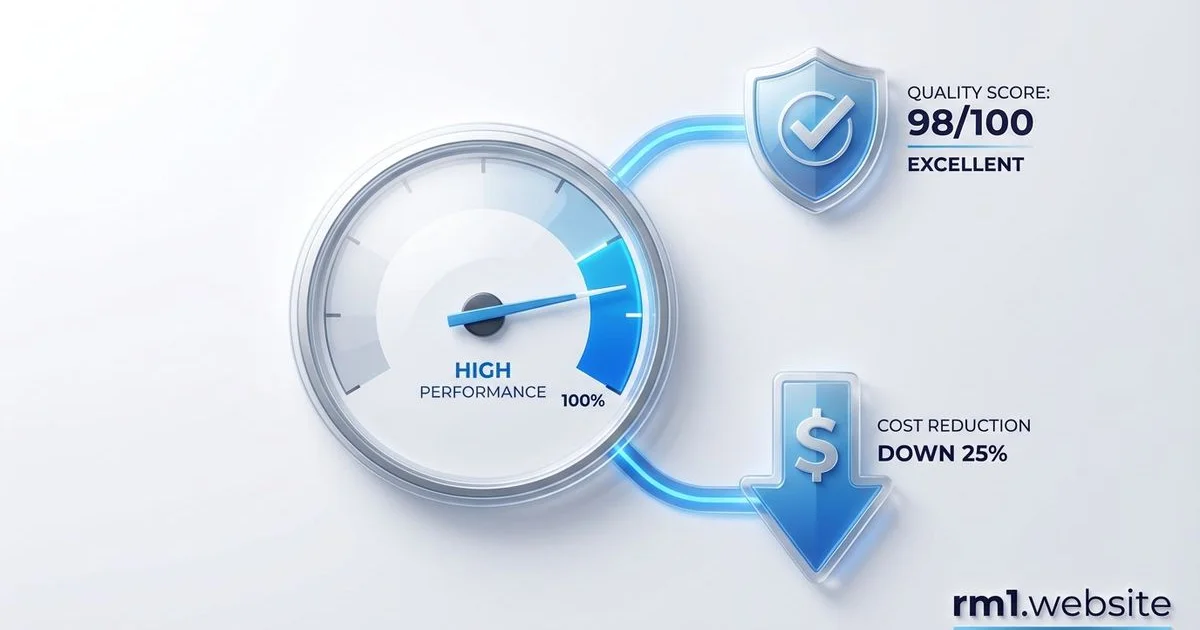
Google Ads uses a metric called Quality Score to determine how much you pay per click and where your ads appear. What most Malaysian business owners do not realise is that your website’s loading speed is a direct factor in that Quality Score calculation. A slow website literally costs you more money on every single click.
I have seen this play out dozens of times with businesses across Malaysia. Two competitors bidding on the exact same keyword, one paying RM3 per click and the other paying RM7, with the only meaningful difference being their website speed. Let me explain how this works and what you can do about it.
Understanding Quality Score
Quality Score is Google’s rating of the quality and relevance of your keywords, ads, and landing pages. It is scored on a scale of 1 to 10, with 10 being the best. This score directly impacts two critical things:
Your cost per click (CPC). A higher Quality Score means you pay less per click. Google rewards advertisers who provide a good user experience with lower costs.
Your ad position. Your ad rank is calculated by multiplying your bid by your Quality Score. A business with a Quality Score of 8 bidding RM5 will outrank a business with a Quality Score of 4 bidding RM8.
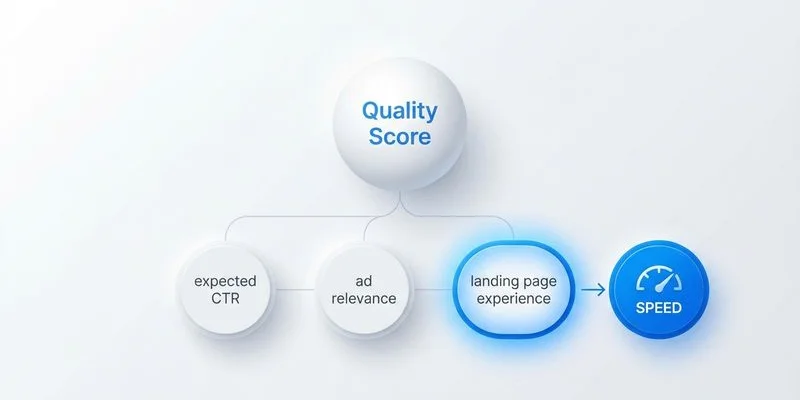
Quality Score is determined by three factors:
- Expected click-through rate (how likely people are to click your ad)
- Ad relevance (how well your ad matches the search intent)
- Landing page experience (this is where website speed comes in)
How Landing Page Experience Is Evaluated
Google evaluates your landing page experience based on several criteria, and page speed is one of the most heavily weighted. Here is what Google looks at:
Page loading speed. Google specifically measures how quickly your page loads on both mobile and desktop devices. They use the same Core Web Vitals metrics as organic search: Largest Contentful Paint (how fast your main content loads), First Input Delay (how quickly your page becomes interactive), and Cumulative Layout Shift (how stable your page is as it loads).
Mobile friendliness. With over 70% of Malaysian internet users on mobile devices, Google heavily penalises landing pages that are not optimised for mobile.
Relevant content. Your landing page content should match the search intent and your ad copy.
Easy navigation. Users should be able to find what they need without confusion.
Trustworthiness. SSL certificates (HTTPS), clear contact information, and professional design all contribute.
Of these factors, page speed is the one that most directly and measurably affects your Quality Score. Google has explicitly stated that slow-loading pages result in lower landing page experience scores.
The Real Cost Impact for Malaysian SMEs
Let me put this in numbers that matter to a Malaysian business owner’s bottom line.
Assume you are bidding on the keyword “accountant Kuala Lumpur” with a monthly Google Ads budget of RM2,000.
| Scenario | Quality Score | Avg. CPC | Monthly Clicks | Monthly Leads (5% rate) |
|---|---|---|---|---|
| Slow website (5+ seconds) | 4/10 | RM8.00 | 250 | 12-13 |
| Average website (3 seconds) | 6/10 | RM5.50 | 364 | 18 |
| Fast website (under 2 seconds) | 8/10 | RM3.50 | 571 | 28-29 |
With the exact same RM2,000 budget, a fast website generates more than double the leads of a slow website. That is not a marginal difference, it is a transformative one. Over a year, that is the difference between 150 leads and 340 leads from the same ad spend.
I have worked with a home services company in Penang that was spending RM3,000 per month on Google Ads with a slow WordPress website. Their average CPC was RM9.40 and their Quality Score hovered around 3 to 4. After migrating to a fast static website, their Quality Score jumped to 7 to 8, their CPC dropped to RM4.20, and they nearly doubled their monthly leads without increasing their budget by a single ringgit.
What Google PageSpeed Score Should You Target
Google PageSpeed Insights scores your website from 0 to 100. For optimal Google Ads performance, here are the benchmarks you should aim for:
90 to 100 (Green). Excellent. This is where you want to be. Static websites built with modern frameworks consistently score in this range. Your Quality Score will benefit significantly.
50 to 89 (Orange). Needs improvement. Most WordPress sites with multiple plugins fall in this range. Your Quality Score is being negatively impacted, but it is not catastrophic.
0 to 49 (Red). Poor. If your website scores in this range, you are almost certainly paying a premium on every Google Ads click. Many free Wix and Squarespace sites, along with bloated WordPress sites, fall here.
The average Malaysian business website scores between 30 and 55 on mobile PageSpeed. That means the majority of Malaysian SMEs running Google Ads are paying more per click than they need to because of their website speed.
Quick Wins to Improve Your Landing Page Speed
If you are currently running Google Ads and cannot rebuild your website immediately, here are some quick fixes that can improve your landing page speed:
Compress your images. Large, uncompressed images are the number one cause of slow websites in Malaysia. Use tools like TinyPNG or ShortPixel to compress every image on your landing pages. A single unoptimised hero image can add 3 to 5 seconds to your load time.
Remove unnecessary plugins. If you are on WordPress, every plugin adds weight to your page. Audit your plugins and remove anything that is not essential. Many Malaysian business websites have 15 to 20 plugins installed when they only need 5 to 7.
Enable caching. Browser caching stores parts of your website on the visitor’s device so repeat visits load faster. Most hosting providers offer caching options, and WordPress plugins like WP Super Cache can help.
Minimise JavaScript and CSS. Every script and stylesheet on your page takes time to download and process. Remove any tracking scripts, widgets, or features that are not essential to your landing page.
Choose better hosting. Many Malaysian businesses use the cheapest shared hosting plans. Upgrading to a better hosting provider or plan can cut your load time significantly. Even better, consider a fast static website that loads from a global CDN.

The Long-Term Solution: Build a Fast Website
While quick fixes help, the most impactful solution is having a website that is inherently fast. Static websites built with modern technology consistently score 95 or above on Google PageSpeed because they:
- Serve pre-built HTML pages instead of generating pages on every visit
- Deliver content through global CDNs (Content Delivery Networks) for lightning-fast loading in Malaysia
- Do not rely on databases or server-side processing
- Have no plugins to slow things down
- Use optimised, modern code with minimal overhead
This is exactly why the RM1 Website Package is built on Astro static site technology. Every website scores 95 or above on PageSpeed out of the box, giving your Google Ads campaigns the best possible Quality Score foundation.
The Compounding Effect of Speed
Here is what makes this so powerful. A faster website does not just lower your Google Ads costs. It also improves your conversion rate. Google’s own research shows that:
- 53% of mobile users abandon a site that takes more than 3 seconds to load
- Every additional second of load time reduces conversions by 7%
- Pages that load in 2 seconds have a 15% higher conversion rate than pages that load in 5 seconds
So a fast website gives you a double benefit: more clicks per ringgit spent on ads (lower CPC), and more conversions per click (higher conversion rate). These two improvements multiply each other, creating a compounding effect that transforms your Google Ads ROI.
Check Your Website Speed Today
Before you spend another ringgit on Google Ads, go to Google PageSpeed Insights and test your landing page. If your mobile score is below 70, you are almost certainly overpaying for every click.
The money you save by fixing your website speed will likely exceed the cost of the fix itself within a few months. It is the single highest-ROI improvement most Malaysian SMEs can make to their Google Ads performance, and yet it is the one most businesses overlook because they focus entirely on their ad account and ignore the foundation underneath it.
Your ads are only as effective as the website they send traffic to. Make sure that website is fast enough to deserve your ad budget.
Need a Website for Your Business?
Get a complete 15-page website for just RM1/day. No hidden fees.
WhatsApp Us