15-Page Website vs 40+ Page Website: The Real SEO Impact for Local Businesses
Does page count matter for SEO? We compare the ranking performance of smaller vs comprehensive websites for Malaysian businesses.
Adam Yong
RM1 Website
Does Page Count Actually Affect Your Google Rankings?
This is one of the most common questions I get from Malaysian business owners: “Adam, do I really need 40 pages? My competitor has a 5-page website and they seem to be doing fine.” It is a reasonable question. After all, nobody wants to pay for content they do not need.
But after 20 years of tracking SEO performance across hundreds of Malaysian business websites, I can tell you with certainty that page count matters, not because Google counts your pages, but because more topically relevant pages create a compound effect that smaller websites simply cannot replicate.
Let me show you the data and break down exactly why this happens.
The Correlation Between Content Depth and Rankings
Let me be clear about something: Google does not rank websites based on page count alone. You cannot create 40 pages of garbage and expect to outrank a well-optimised 15-page website. Quality always comes first.
However, when the quality is equal, the website with more comprehensive topical coverage will win nearly every time. Here is why.
Google’s algorithm works by evaluating how well a website covers a topic as a whole. A website with 15 pages can cover the basics of a topic. A website with 40+ pages can cover the basics plus every subtopic, every variation, every question a searcher might ask, and every related concept.
When Google has to choose between two websites to rank for a search query like “best dentist in Subang Jaya,” it looks at the entire website, not just the one page that matches the query. The website that demonstrates comprehensive dental expertise through dozens of detailed pages gets preferred over the website with a single generic “Our Services” page.

What a 15-Page Website Typically Looks Like
A typical 15-page Malaysian SME website includes:
- Homepage
- About Us
- 3-5 Service pages
- Blog (with 3-5 posts)
- Contact page
- Privacy Policy / Terms
- 1-2 Location or area pages
This covers the basics. A potential customer can learn what you do, where you are located, and how to contact you. For brand new businesses with zero online presence, this is a solid starting point and infinitely better than having no website at all.
The problem is that this structure limits your SEO ceiling. With 15 pages, you might rank for 5 to 15 keywords. You will pick up some branded searches (people looking for your business name) and maybe a few service-related terms if competition is low.
What a 40+ Page Website Looks Like
A comprehensive 40+ page website for the same business includes everything above, plus:
- Detailed service pages for every individual service (not bundled together)
- Pillar content that thoroughly covers each core topic
- 15-20 blog posts addressing specific customer questions and problems
- Location pages for each area served
- FAQ sections with detailed answers
- Case studies or project showcases demonstrating expertise
- Comparison and guide content that captures informational searches
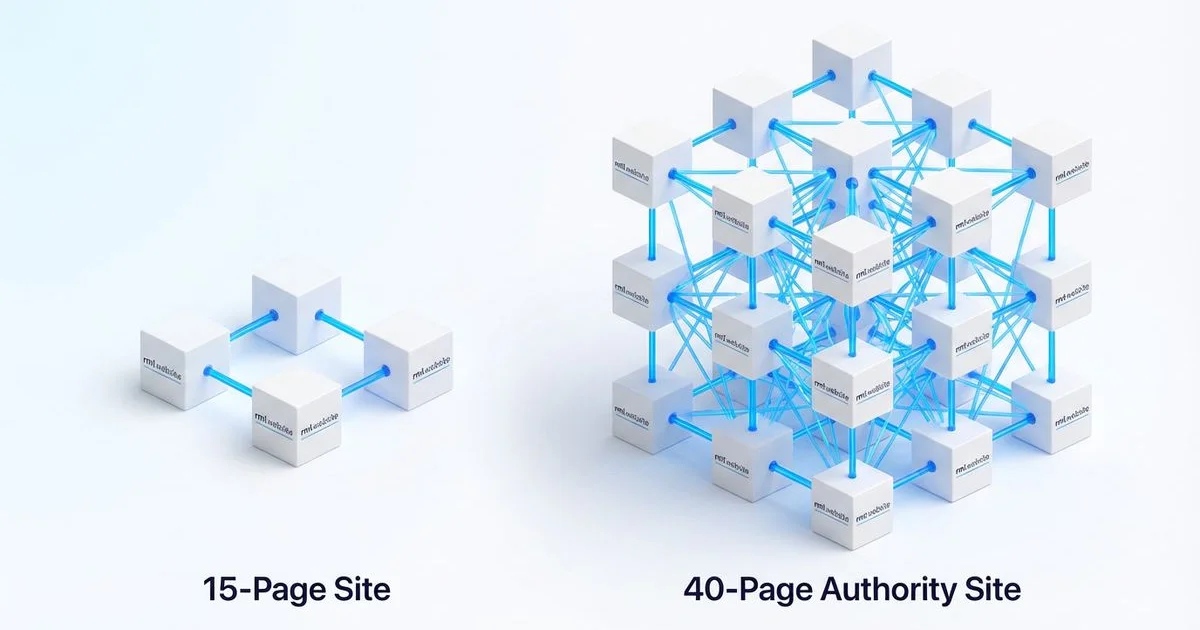
This structure creates a web of interconnected content that Google can crawl and index. Each page targets different search queries while reinforcing the site’s overall topical authority.
The Compound Effect of Comprehensive Content
Here is where the magic happens, and where most Malaysian business owners miss the opportunity. Each page on your website does not just rank for its own target keyword. It contributes to the ranking potential of every other page on your site.
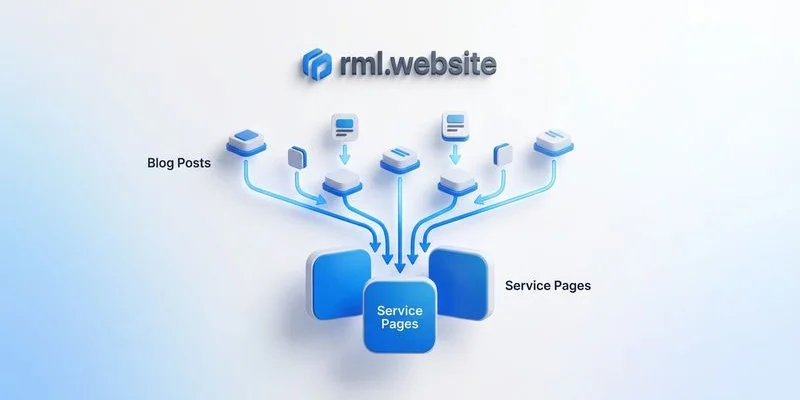
When your dental clinic website has a blog post about “how to choose the right toothbrush” and it links to your “teeth cleaning service” page, it sends a signal to Google that your website has genuine dental expertise. That signal helps your service page rank higher. Multiply this effect across 25 blog posts, each linking to relevant service pages, and the compound effect is significant.
I have tracked this phenomenon across Malaysian business websites for years. Here is what the data typically shows:
| Metric | 15-Page Website | 40+ Page Website |
|---|---|---|
| Keywords Ranked (Top 100) | 50-150 | 300-800+ |
| Keywords in Top 10 | 5-15 | 30-80+ |
| Monthly Organic Traffic | 200-800 visits | 1,500-5,000+ visits |
| Long-tail Keywords Captured | Minimal | Hundreds |
| Featured Snippets | Rare | Regular |
These numbers are based on averages across real Malaysian business websites I have monitored. The 40+ page websites consistently outperform their smaller counterparts by a factor of 3 to 5 times.
The Long-Tail Keyword Advantage
One of the biggest benefits of a larger website is the ability to capture long-tail keywords. These are specific, multi-word search phrases that individually get fewer searches but collectively drive massive traffic.
For example, a 15-page plumbing website might rank for “plumber Kuala Lumpur.” But a 40-page plumbing website might also rank for:
- “how to fix leaking pipe under sink”
- “water heater installation cost Malaysia”
- “best time to replace old pipes”
- “emergency plumber Bangsar 24 hours”
- “how to unclog drain without chemicals”
- “signs you need pipe replacement”
- “plumber near me PJ Damansara”
Each of these long-tail keywords represents a potential customer at a different stage of the buying journey. The person searching “how to fix leaking pipe” might try the DIY approach, fail, and then call you. The person searching “emergency plumber Bangsar 24 hours” is ready to hire right now. A comprehensive website captures both.
The Content Cluster Strategy
The most effective approach for a 40+ page website is content clustering. This means organising your content around core topics (pillar pages) supported by detailed subtopic pages (cluster content).
Here is an example for an accounting firm in Malaysia:
Pillar: Tax Planning Services
- Blog: “Complete Guide to Personal Tax Filing in Malaysia”
- Blog: “Tax Deductions Malaysian Business Owners Often Miss”
- Blog: “When Should You Hire a Tax Accountant?”
- Blog: “SST vs GST: What Malaysian Businesses Need to Know”
- FAQ: “Tax Planning Frequently Asked Questions”
Pillar: Audit Services
- Blog: “How to Prepare for Your First Company Audit”
- Blog: “What Happens During a Statutory Audit in Malaysia”
- Blog: “Common Audit Findings for Malaysian SMEs”
- FAQ: “Audit Services FAQ”
Each cluster reinforces the others. Google sees a comprehensive coverage of accounting topics and rewards the entire site with higher rankings. A competing firm with just a “Services” page covering all of this in 200 words cannot compete.
But What About Quality Over Quantity?
Absolutely, quality matters more than quantity. I would take a 15-page website with excellent, detailed content over a 40-page website filled with thin, AI-generated fluff any day. Google’s Helpful Content System specifically targets low-quality content, regardless of how much of it you have.
The goal is not to create pages for the sake of page count. The goal is to comprehensively cover your topic with genuinely helpful, expert-level content. If your business has enough depth to warrant 40+ pages (and most do), then building out that content is the single best SEO investment you can make.
The key is ensuring every page serves a purpose. Every page should answer a specific question, target a specific search intent, or provide genuine value to your potential customers. No filler. No fluff. No repetition.
The Cost Factor for Malaysian SMEs
I understand the hesitation. Building a 40-page website through a traditional agency in Malaysia can cost RM15,000 to RM30,000. That is a significant investment for an SME.
This is exactly why I developed the Authority Pack. It delivers the comprehensive content structure needed for topical authority at a fraction of what traditional agencies charge. Combined with the RM1 Website Package for the technical foundation, Malaysian SMEs can build authority-level websites without the enterprise price tag.
My Recommendation: Start Strong, Scale Up
If you are starting from zero, begin with the essentials. Get a professional 15-page website up and running with proper SEO foundations. This gives you an immediate online presence and starts building your domain authority.
Then, scale up strategically. Add 2-4 pieces of new content per month, each targeting specific keywords in your niche. Within 6 to 12 months, you will have a 40+ page website that ranks for hundreds of keywords and generates consistent organic traffic.
For those who want to accelerate this process, the Authority Pack builds the comprehensive content structure from day one, giving you an immediate topical authority advantage over competitors who are still running 5-page template websites.
The Bottom Line
Page count is not a ranking factor in itself, but the topical authority that comes from comprehensive content coverage absolutely is. A well-structured 40+ page website will outperform a 15-page website in organic search visibility by 3 to 5 times or more.
For Malaysian SMEs competing in local search, this is not a nice-to-have. It is a competitive necessity. The businesses investing in comprehensive content now are the ones that will dominate their local search results for years to come.
Need a Website for Your Business?
Get a complete 15-page website for just RM1/day. No hidden fees.
WhatsApp Us